How many calories are in a poke bowl? From 450 to over 1,200 kcal
Poke bowl calories range from 450 to over 1,200 kcal depending on the rice, fish and sauce, based on Ciqual and USDA data. Salmon, tuna, shrimp or tofu, spicy mayo or soy sauce: the real numbers.
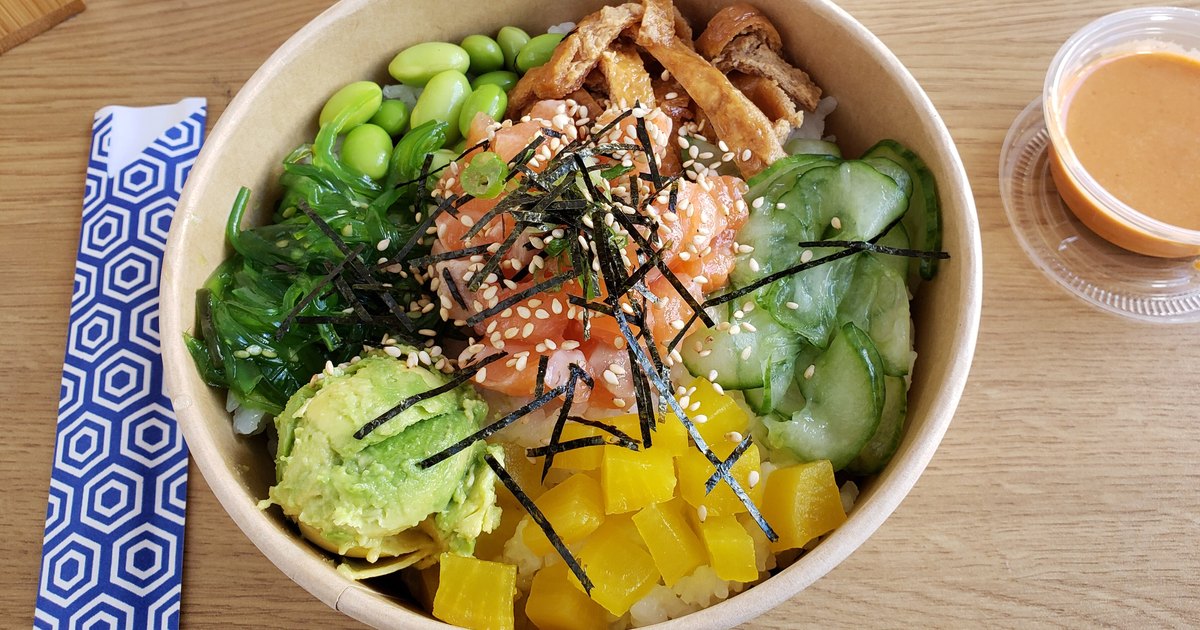
Lunch break. You walk past the poke bar and think: this is today’s healthy choice. Raw fish, veggies, avocado, all those colours. And you’re right, it’s a good meal. But between a tightly packed scoop of rice, a whole avocado and spicy mayo dripping everywhere, the numbers climb faster than you’d think.
So how much does a poke bowl really add up to?
Short answer: a classic salmon poke bowl (200 g of rice, 100 g of salmon, avocado, edamame, veggies, soy sauce and spicy mayo) comes to about 880 kcal. Skip the mayo and it drops to 740 kcal. With tuna and just soy sauce, count on roughly 660 kcal. And a large bowl with a double helping of sauce easily goes past 1,200 kcal. The figures come from the French Ciqual 2025 food composition table (Anses), with USDA data for the edamame.
Where do the calories in a poke bowl come from?
A poke bowl is always built the same way: a base, a protein, toppings, a sauce and a crunchy finish. Here’s what each piece adds up to, using the portions you typically find in a “regular” bowl:
- Rice (200 g cooked): about 310 kcal. That’s the biggest share of the bowl. Sushi rice is also seasoned with vinegar, sugar and salt: one teaspoon of sugar adds another 20 kcal.
- Raw salmon (100 g): 193 kcal for farmed salmon. It’s fattier than other fish, which is also what makes it so good.
- Raw tuna (100 g): 112 kcal for yellowfin, almost half as much as salmon.
- Avocado (half an avocado, about 50 g of flesh): 102 kcal.
- Edamame (40 g): 48 kcal, plus a nice dose of plant protein.
- Mango (40 g): 28 kcal.
- Cucumber, carrot, red cabbage: barely 20 kcal for a good handful. Pile them on.
- Sesame seeds (one teaspoon, 5 g): 29 kcal.
- Soy sauce (one tablespoon, 15 g): only 6 kcal, but plenty of salt.
- Spicy mayo (20 g): about 138 kcal. That’s the real surprise in the bowl.
How many calories, bowl by bowl?
To compare, we keep the same base every time: 200 g of white rice, 100 g of protein, half an avocado, edamame, mango, cucumber, carrot, red cabbage, sesame and soy sauce.
| Poke bowl | What’s in it | Calories (approx.) |
|---|---|---|
| Light, half rice | 100 g of rice, tuna, lots of veggies, soy sauce | 445 kcal |
| Shrimp | Base + 100 g of shrimp, soy sauce | 640 kcal |
| Tuna | Base + 100 g of tuna, soy sauce | 660 kcal |
| Tofu | Base + 100 g of tofu, soy sauce | 695 kcal |
| Salmon | Base + 100 g of salmon, soy sauce | 740 kcal |
| Salmon + spicy mayo | Base + salmon, soy sauce and 20 g of spicy mayo | 880 kcal |
| Large salmon bowl, double sauce | 300 g of rice, 120 g of salmon, extra avocado, sweet soy sauce and 30 g of mayo | 1,230 kcal |
Calculated from the Ciqual 2025 values for each ingredient (USDA for edamame). Macro-wise, the salmon bowl with spicy mayo works out at roughly 36 g of protein, 81 g of carbs and 44 g of fat. The tuna bowl without mayo: 40 g of protein, 81 g of carbs and 18 g of fat.
One caveat: every poke bar has its own portions. Some serve 150 g of rice, others nearly 300 g. The figures in the table are reference points, not absolute truth.
Want to know what your bowl really adds up to? Snap it before you mix it. Try BiteFrame →
How does it compare with other dishes?
A salmon poke bowl with spicy mayo (880 kcal) is heavier than a plate of chicken couscous (about 760 kcal) and well above a croque-monsieur (400 to 600 kcal). It’s on par with a generous restaurant portion of moussaka (400 to 800 kcal). The large bowl with double sauce lands next to raclette (around 1,100 kcal) and a big plate of mussels and fries. The difference is that a well-built poke bowl brings lots of protein, good fats and vegetables. It really keeps you full.
How to build a lighter bowl that still feels like a treat
- Ask for half rice, half salad. It’s the move that pays off most: about 150 kcal less, and the bowl stays just as generous.
- Get the sauce on the side. One spoonful of spicy mayo is nearly 70 kcal. When you pour it yourself, you often use half as much.
- Go for soy sauce or ponzu. Lots of flavour for very few calories. Just keep an eye on the salt.
- Switch up the fish. Tuna or shrimp save 80 to 100 kcal compared with salmon. Salmon is still a great choice, rich in omega-3s: it’s just about balance over the week.
- Half an avocado is plenty. It’s delicious, but a whole one adds over 200 kcal.
- Watch the crunchy toppings. Fried onions, tempura flakes, prawn crackers: they add fat without you noticing.
- Load up on veggies. Cucumber, cabbage, radish, carrot, seaweed: they fill the bowl for next to nothing.
Make your own poke bowl: open the fridge
A poke bowl is the perfect fridge-clearing meal. Leftover rice, a tin of tuna or a salmon fillet, a lonely cucumber, a ripe avocado… Snap a photo of your fridge with BiteFrame. In the app’s camera, next to product and barcode scanning, the “What should I cook?” option spots your ingredients and suggests recipes with what you already have. Quite often, there’s a great bowl waiting in there without you knowing it.
Estimate your poke bowl from a photo with BiteFrame
A poke bowl looks easy to count, but it’s a trap: the rice hides under the toppings and the sauce vanishes once it’s mixed in. With BiteFrame, you take a photo of your bowl and the AI estimates the calories and macros. Easiest way: one shot from above just before you mix, with the sauce visible. If you buy a ready-made bowl at the supermarket, scan the barcode to get the label values. It’s still an estimate: double-check the amount of rice and sauce, and adjust if needed.
Quick questions
How many calories are in a salmon poke bowl?
About 740 kcal for a regular bowl with soy sauce, and 880 kcal with 20 g of spicy mayo. A large bowl with more rice and sauce can go past 1,200 kcal.
Is a poke bowl good for weight loss?
It can be: it brings protein, vegetables and good fats, and it’s very filling. For a lighter meal, ask for half rice, half salad, pick tuna or shrimp and get the sauce on the side. That puts you at around 450 to 550 kcal.
How many calories are in poke bowl rice?
About 155 kcal per 100 g of cooked white rice (Ciqual), so 310 kcal for a 200 g portion. Brown rice is slightly higher (187 kcal per 100 g), but it brings more fibre.
How many calories are in spicy mayo?
It’s mostly mayonnaise (692 kcal per 100 g according to Ciqual) with a little hot sauce. Count about 140 kcal for 20 g and 210 kcal for 30 g.
Which fish makes the lightest poke bowl?
Tuna (112 kcal per 100 g) and shrimp (91 kcal) are the lightest. Farmed salmon goes up to 193 kcal, but it brings omega-3s. All three are great choices.
This information is for general guidance only and does not replace advice from a healthcare professional.
Sources
Photo: Andy Li (Onthewings), Wikimedia Commons (cropped), CC0