How many calories in a raclette? 700 to 1,600 kcal a night
Raclette cheese is 342 kcal per 100 g (Ciqual), so a raclette night with potatoes and cured meats comes to 700–1,600 kcal. The numbers, and how to go lighter.
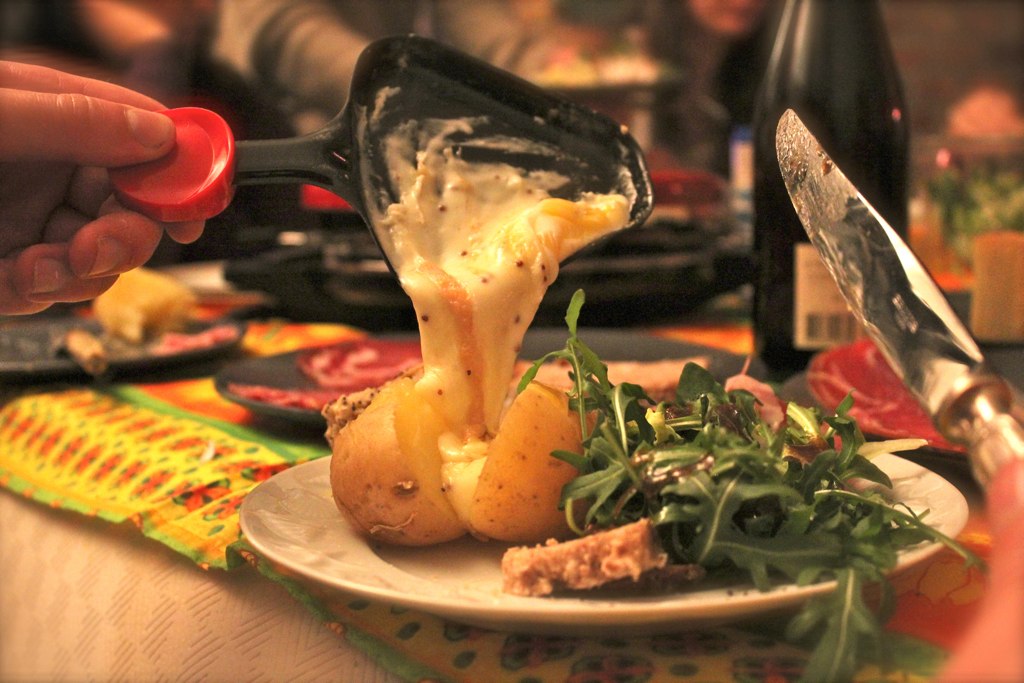
It's dark by five. Someone digs the raclette grill out of the cupboard, the table fills up with ham, gherkins and steaming potatoes, and everyone agrees: nobody's counting tonight. Then the third little pan of cheese comes off the grill.
You don't have to spoil the evening to know roughly where you stand.
Short answer: a "standard" raclette, with 200 g of cheese, three good-sized potatoes and a plate of cured meats, comes to around 1,100 kcal per person. Keep it light and you're closer to 700 kcal. Big appetite, plus bread and wine, and you'll sail past 1,600 kcal. The cheese itself is 342 kcal per 100 g in the 2025 Ciqual table, the food composition database run by Anses, France's food safety agency.
It's (almost) all about the cheese
On a standard plate, the cheese alone makes up about 60% of the calories. Here's how it breaks down:
- The cheese: 200 g per adult is the amount you'll see recommended pretty much everywhere. That's about 680 kcal. A 30 g slice is roughly 100 kcal, so six or seven pans and you're there.
- The potatoes: they get the blame, and they don't deserve it. 250 g of boiled potatoes is only around 200 kcal. It's what you pour over them that counts.
- The cured meats: this is where the gap gets huge. 30 g of cooked ham comes to roughly 35 kcal. The same amount of rosette, a fatty French dry sausage, is nearly 120 kcal.
- Gherkins and pickled onions: next to nothing. Help yourself.
- The drinks: a 125 ml glass of dry white wine is about 70 kcal. A 33 cl bottle of 5–6% beer is around 185 kcal, and a tripel or other strong Belgian beer is more like 200 kcal or above. And let's be honest, it's rarely just the one.
Three nights, three totals
| Night | On the plate | Calories (approx.) |
|---|---|---|
| Light | 120 g cheese, 250 g potatoes, 30 g cooked ham, 30 g bresaola-style air-dried beef (viande des Grisons), a big salad, gherkins | 730 kcal |
| Standard | 200 g cheese, 250 g potatoes, 100 g mixed cured meats (dry-cured ham, cooked ham, rosette, coppa), gherkins | 1,130 kcal |
| Big appetite | 250 g cheese, 300 g potatoes, 150 g cured meats, a slice of bread | 1,590 kcal |
Worked out from the Ciqual 2025 values for each food, drinks not included (two glasses of white wine add another 140 kcal). In macros, the standard night is roughly 76 g of protein, 71 g of fat and 45 g of carbs.
Curious what your plate actually adds up to? Snap it before the first pan goes in. Try BiteFrame →
How does it compare with other comfort food?
A standard raclette is up there with the heaviest meals. A restaurant portion of moussaka is 400 to 800 kcal, a plate of couscous 500 to 1,000 kcal, and moules-frites anywhere from 500 to 1,500 kcal. Even a croque monsieur, hardly known as diet food, stays between 400 and 600 kcal.
So raclette is a feast. That's fine, as long as you know it.
How to lighten it without killing the mood
- Set your cheese aside at the start. Three or four slices in front of you, instead of grabbing from the shared board. Nothing else makes as big a difference.
- Go for leaner meats: cooked ham, air-dried beef, back bacon. Keep the rosette and salami for one or two treat slices.
- Put vegetables in the pan: mushrooms, peppers, onions, a few strips of chicory. They melt under the cheese and take the place of a slice of sausage.
- Put a big green salad on the table with a light dressing. It cuts through the richness and fills you up.
- Keep the potatoes, just count them. Two or three is plenty.
- Alternate with water, especially once the white wine gets going.
The next day: what to do with the leftovers?
There's always a chunk of cheese, a couple of potatoes and three slices of ham left over. Before you end up doing raclette again for lunch, open the fridge and take a photo of it with BiteFrame. In the app's camera, the "What am I cooking?" option spots your ingredients and suggests recipes with what you've got. With raclette leftovers, that could be an omelette, pan-fried potatoes or a savoury tart, depending on what else is in there.
Estimate your raclette from a photo with BiteFrame
Raclette might be the hardest meal of all to judge by eye: you eat it in rounds, the cheese melts into the potatoes, and nobody keeps track of the slices. With BiteFrame, you take a photo of your plate and the AI estimates the calories and macros. The easiest way: one photo of your cheese and meat before you start, or one photo per round. If your cheese came in a packet, scan the barcode to get the values from the label. It's still an estimate, so adjust the portion if you need to.
Quick questions
How many calories in a slice of raclette cheese?
About 100 kcal for a 30 g slice, based on the Ciqual value (342 kcal per 100 g). A thin 20 g slice is more like 70 kcal.
How much raclette cheese per person?
The usual rule is 200 g per adult when raclette is the main meal, and 150 g for smaller appetites. Going from 200 g to 150 g saves you about 170 kcal.
Is raclette without cured meats much lighter?
A bit. On the standard night, dropping the 100 g of meats takes off roughly 240 kcal. But most of the total is still the cheese.
Is Raclette de Savoie higher in calories?
Barely. Ciqual lists Raclette de Savoie at 357 kcal per 100 g, against 342 kcal for standard raclette cheese. Over a whole evening, the difference is tiny.
This information is for guidance only and does not replace advice from a health professional.