How many calories in a kebab or a dürüm? From 580 to over 1,200 kcal
Kebab and dürüm: from 580 to over 1,200 kcal depending on the bread, the weight and the fries, according to Ciqual. Portion table, sauces and salt.
You leave work hungry and grab a kebab. Pita or dürüm, some salad, some sauce, sometimes fries tucked inside. It goes down fast, and then you wonder: what did I just eat, exactly?
Short answer: a pita kebab of about 350 g, with meat and salad, is about 810 kcal, according to the French Ciqual 2025 table from ANSES. In a baguette, at the same weight, you are closer to 950 kcal. A small 250 g pita comes down to around 580 kcal. A large 450 g sandwich, or a well-filled dürüm, often goes over 1,000 kcal. Add a portion of fries, and you can climb another 260 to 390 kcal. The sandwich figures come from official entries. The weight itself is not standardised: Ciqual gives values per 100 g, not “per kebab”.
What’s in a kebab, and what actually changes the count
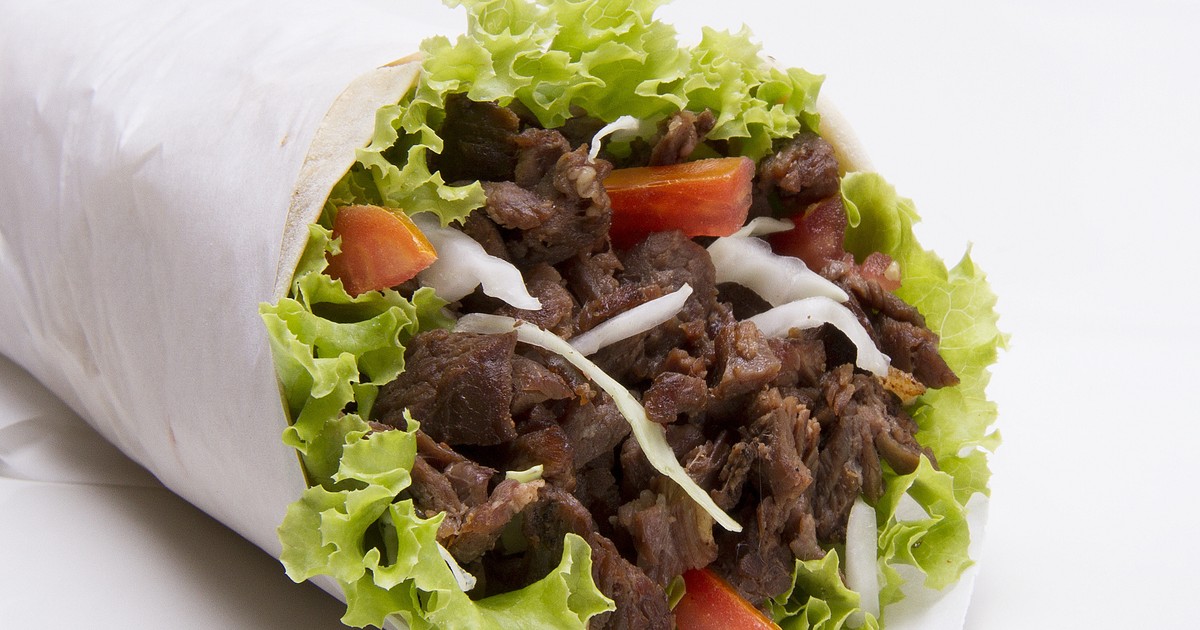
In the photo, it’s a dürüm: flatbread rolled around meat, lettuce, tomato and onion. In Belgium, you often order the same thing as a pita, a baguette, or a dürüm (sometimes spelled durum). The filling is similar: spit-roasted meat (veal, chicken, turkey…), salad, and a sauce. What really moves the calories is the weight, the bread, the sauce and the fries.
Ciqual has two entries for the assembled sandwich:
- Greek-style or kebab sandwich, pita, salad: 232 kcal per 100 g, with 15.2 g of protein, 10.9 g of fat, 17 g of carbohydrate and 1.23 g of salt.
- Greek-style or kebab sandwich, baguette, salad: 272 kcal per 100 g, with 15 g of protein, 9.8 g of fat, 29.9 g of carbohydrate and 1.13 g of salt.
The baguette is more caloric per 100 g, mostly because of the bread: more carbohydrate. Ciqual does not spell out the recipe (how much sauce, which meat). These are averages. There is no “dürüm” entry in that table: the closest official match is the pita kebab — same kind of filling, thinner bread.
How many calories by format and weight?
The weights below are typical orders of magnitude, not official portions. For your own sandwich, the fairest option is still to weigh it, or to photograph it.
| Format | Weight (ballpark) | Calories (about) | Salt (about) |
|---|---|---|---|
| Small pita kebab | 250 g | 580 kcal | 3.1 g |
| Typical pita kebab | 350 g | 810 kcal | 4.3 g |
| Large pita kebab | 450 g | 1,040 kcal | 5.5 g |
| Typical baguette kebab | 350 g | 950 kcal | 4.0 g |
| Large baguette kebab | 450 g | 1,220 kcal | 5.1 g |
| Dürüm (pita value as a guide, no fries) | 400 g | 930 kcal | 4.9 g |
For a typical 350 g pita, that also means about 53 g of protein, 38 g of fat and 60 g of carbohydrate. For the dürüm, we applied the official pita kebab value (232 kcal per 100 g) to 400 g, a weight that is often more generous than a pita. This is not an official “dürüm” entry: it is a guide, and we say so plainly.
Every shop has its own hand. Some sandwiches are lighter, some are packed. These figures are estimates, not an absolute truth.
Want to know what yours is really worth? Take a photo before it is fully wrapped, or as soon as it is on the plate. Try BiteFrame →
The pita version, the one in the Ciqual entry
Here is a kebab in pita bread, with meat, salad, a little carrot and a white sauce. This is the format of the official “pita, salad” entry.
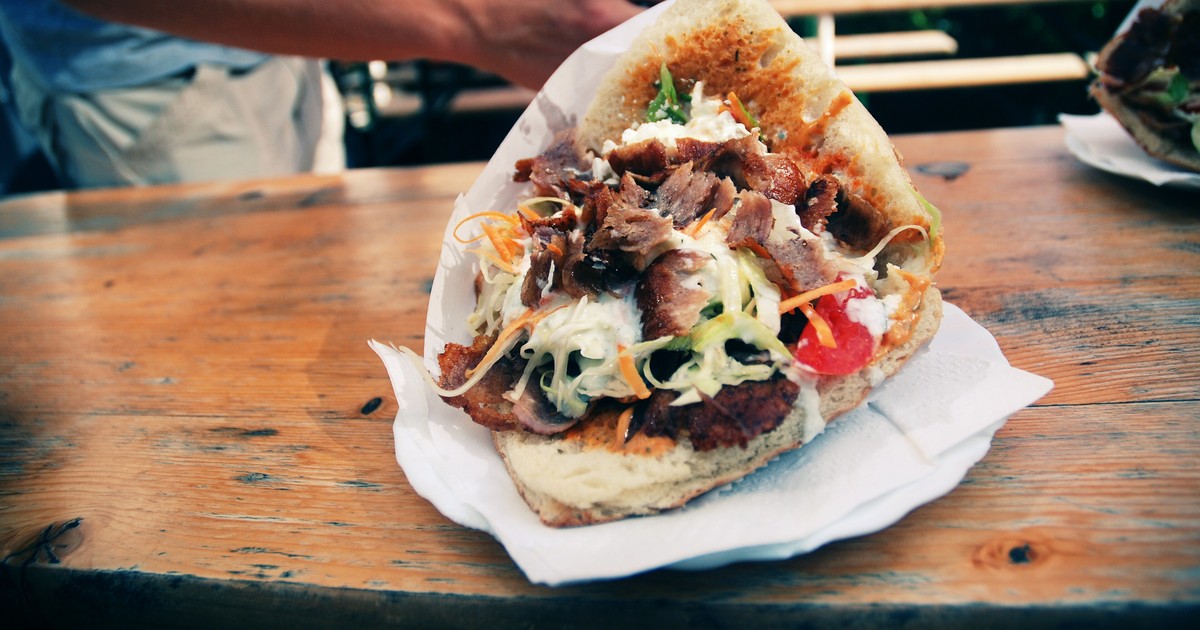
Photo: Alex Kehr, Wikimedia Commons (cropped), CC BY 2.0.
Fries and sauce: what quickly pushes the number up
A Belgian dürüm sometimes comes with fries inside. That is not in the Ciqual sandwich entries. If you add some, they need to be counted separately.
- 100 g of deep-fried fries: about 260 kcal (Ciqual). A 150 g portion is about 390 kcal.
- 30 g of packaged kebab sauce (a little more than a tablespoon): about 130 kcal.
- 30 g of samurai sauce: about 160 kcal.
- 30 g of andalouse sauce: about 160 kcal.
- 30 g of tzatziki: about 40 kcal.
A dürüm of about 400 g (pita guide, no fries) plus 100 g of fries is already around 1,190 kcal. The Ciqual sandwich entry already includes a typical sauce, without saying which one or how much. The 130 kcal above are for extra sauce, or to give you a sense of the gap if yours is generous. We do not add them to the table by default.
One note on the fries: the Ciqual values are for frozen fries. In a chip shop, the oil and the salt added after cooking can change the result, sometimes a lot.
Salt: the thing to watch
The World Health Organization recommends staying under 5 g of salt a day for an adult. A typical 350 g pita kebab already provides about 4.3 g of salt, according to Ciqual. A large 450 g pita goes over 5.5 g: on its own, more than the daily guide. Sauce plays a big part, and chip-shop fries are often salted again, which the frozen-fries entry barely shows (0.073 g of salt per 100 g when deep-fried).
How does that compare with other dishes?
A typical pita kebab (about 810 kcal) sits a little above a pork bibimbap (about 730 kcal) and a plate of chicken couscous (about 760 kcal), and level with a shrimp pad thai (about 820 kcal). A large baguette, or a dürüm with fries, joins a raclette evening (around 1,100 kcal) or a large restaurant bowl. The difference: a kebab also brings a fair amount of protein (around 50 g for a typical pita).
How to lighten your kebab without making it sad
- Ask for a little less bread, or a pita rather than a baguette. At the same weight, the baguette is more caloric.
- Keep the salad. Lettuce, tomato, onion: they fill the sandwich and barely count.
- Have the sauce on the side. A large dollop of kebab or samurai sauce is easily 130 to 160 kcal, plus salt. Taste first, then add more if you want.
- Fries on the side, or to share. An extra 100 g is about 260 kcal. If you really want them, a small portion next to the sandwich is easier to see than a dürüm already packed full.
- Tzatziki instead of kebab sauce. For 30 g, the gap is about 90 kcal, and often less salt.
- Share, or keep half. A large sandwich easily goes past 1,000 kcal on its own.
Got leftover salad in the fridge? That’s enough for a homemade dürüm
A homemade dürüm is often what’s already there: leftover chicken, a bit of salad, a tomato, an onion, a wrap or some flatbread. Take a photo of your fridge with BiteFrame: in the app’s camera, next to the product scan and the barcode, the “What can I cook?” option spots the ingredients and suggests recipes with what you have. Often, there’s already enough for a wrap, with no need to order in.
Estimate your kebab from a photo with BiteFrame
A kebab is a sandwich where everything is hidden: the meat, the sauce, sometimes the fries. Hard to count in your head. With BiteFrame, you take a photo and the AI estimates the calories and macros. The simplest way: a photo of the sandwich open, or of the dürüm still half rolled, so the filling is visible. If you buy a ready-made kebab at the supermarket, scan the barcode for the label values. It remains an estimate: check the weight, the sauce and the fries in particular, and adjust if needed.
Quick questions
How many calories in a kebab?
About 810 kcal for a typical 350 g pita kebab (meat and salad), according to Ciqual. A small 250 g pita is around 580 kcal, and a large 450 g one around 1,040 kcal. In a baguette, at the typical 350 g weight, count closer to 950 kcal.
How many calories in a dürüm?
Ciqual has no “dürüm” entry. Using the pita kebab value (232 kcal per 100 g) for a wrap of about 400 g, you land around 930 kcal, without fries. With an extra 100 g of fries, that’s about 1,190 kcal. This is a guide, not an official dürüm measurement.
Is a kebab too salty?
A typical 350 g pita already provides about 4.3 g of salt, close to the 5 g a day the WHO recommends for an adult. A large pita goes past that guide on its own. The sauce and the salt on the fries weigh heavily.
Pita, baguette or dürüm: which is the lightest?
At the same weight, the pita is less caloric than the baguette (232 versus 272 kcal per 100 g). The dürüm has no official entry: it is often larger, and sometimes filled with fries. The fairest approach is to look at the weight and what’s inside.
How many calories in kebab sauce?
About 130 kcal for 30 g of packaged kebab sauce, about 160 kcal for the same amount of samurai or andalouse sauce, and about 40 kcal for tzatziki. The Ciqual sandwich entry already includes a typical sauce: these figures are mainly useful if you add more, or if you want to compare sauces.
This information is provided as a guide and does not replace advice from a health professional.