How many calories in a burrito? From 340 to over 900 kcal
A beef burrito: about 600 kcal for 350 g, according to Ciqual. Portion table, chicken version, guacamole, chips and salt.

You order a burrito, you hold it with both hands, and you wonder: what did I just eat, exactly?
Short answer: a beef burrito of about 350 g is about 600 kcal, according to the Anses Ciqual 2025 table. A smaller one, around 200 g, comes down to 340 kcal. A large 450 g burrito reaches about 770 kcal. The most generous ones, around 550 g, often go past 900 kcal. Those calories come from an official entry, per 100 g. The weight itself is not standardised: Ciqual does not define “one burrito”.
What goes into a burrito, and what that changes
In the photo, it is a burrito already rolled in a wheat tortilla, with salsa, guacamole, a little coriander and a spoonful of cream on top. In Belgium, you find them in restaurants, on delivery, or ready-made at the supermarket. Inside, typically: a wheat tortilla, beef or chicken, often rice, beans, cheese, raw vegetables, a sauce.
The Ciqual table has an entry for the assembled dish:
- Beef burritos: 170 kcal per 100 g, with 8 g of protein, 8.5 g of fat, 14.3 g of carbohydrate, 1.9 g of fibre and 0.75 g of salt.
This is an average. Ciqual does not spell out the recipe (how much rice, cheese or sauce). A burrito heavy on cheese or cream will be more caloric, at the same weight, than one filled mostly with vegetables and beans. The photo shows a burrito as it is often served in a restaurant: you cannot see the type of meat inside. The figures in the table come from the “beef burritos” entry.
How many calories by weight?
The weights below are typical orders of magnitude, not official portions. A supermarket burrito is often smaller. A well-filled “mission” burrito can go over half a kilo. For yours, the fairest approach is still to weigh it, or to photograph it.
| Format | Weight (order of magnitude) | Calories (approx.) | Salt (approx.) |
|---|---|---|---|
| Small / compact burrito | 200 g | 340 kcal | 1.5 g |
| Typical burrito | 350 g | 600 kcal | 2.6 g |
| Large burrito | 450 g | 770 kcal | 3.4 g |
| Very large burrito | 550 g | 940 kcal | 4.1 g |
For a typical 350 g burrito, that is also about 28 g of protein, 30 g of fat, 50 g of carbohydrate and 7 g of fibre. The 600 kcal figure is 595 kcal (170 × 3.5) rounded.
Every kitchen has its own hand. Some roll a tight, compact burrito, others fill it generously. These figures are estimates, not an absolute truth.
Want to know what yours is really worth? Take a photo before it is fully rolled, or as soon as it is on the plate, ideally cut in half. Try BiteFrame →
The chicken version, cut in half
Here is a burrito, opened: you can make out rice, melted cheese and tomato, with cream on the side. There is no “chicken burrito” entry in Ciqual. The closest one is a chicken fajita, home-prepared with a kit: 158 kcal per 100 g. For 350 g, that is about 550 kcal, and about 3.1 g of salt. This is a benchmark, clearly presented as such: a fajita is not a burrito, even if the filling looks similar.
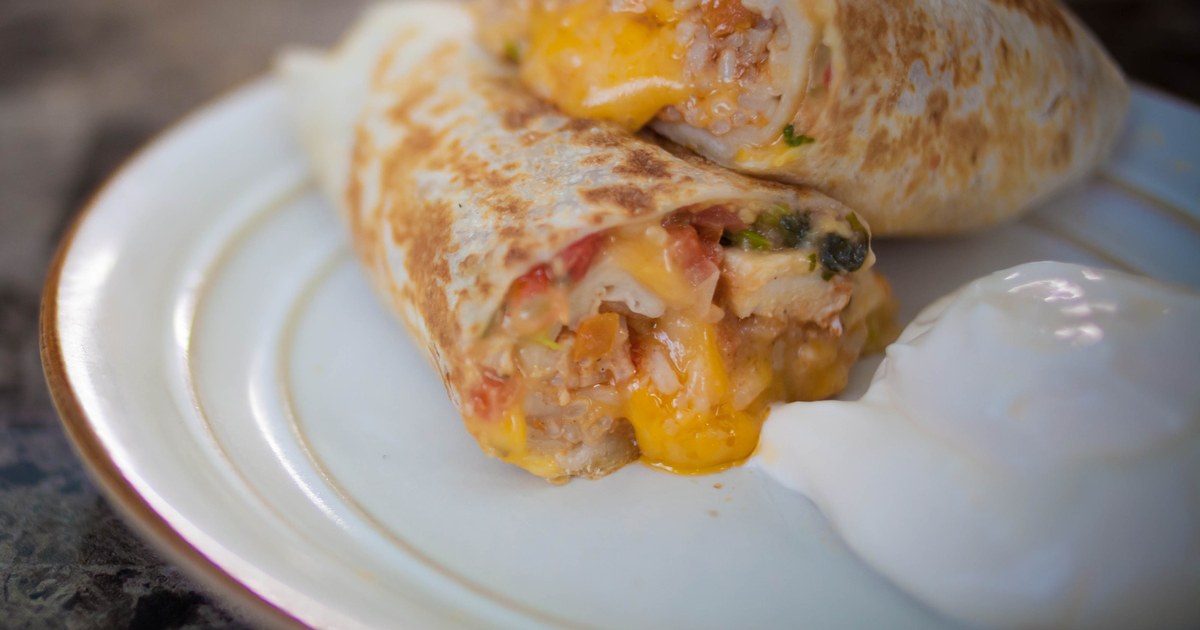
Photo: Sodanie Chea, Wikimedia Commons (cropped), CC BY 2.0.
The extras: what quickly raises the total
Guacamole, chips and a side of rice are not in the burrito entry. If you add them, they need to be counted separately.
- 30 g of pre-packaged guacamole: about 60 kcal (Ciqual).
- 30 g of plain corn chips: about 150 kcal. A small bowl of 50 g is about 240 kcal.
- 150 g of cooked white rice on the side: about 230 kcal.
The Ciqual burrito entry already includes a typical filling, without saying whether there is guacamole or cream, or how much. The calories above are for extras on the side, or for a visibly generous sauce. We do not add them to the main table by default.
Salt: the figure to watch
The World Health Organization recommends staying under 5 g of salt a day for an adult. A typical 350 g burrito already provides about 2.6 g of salt, according to Ciqual. A very large 550 g burrito rises to about 4.1 g: on its own, a large share of the daily benchmark. Corn chips and some sauces add still more salt.
And compared with other dishes?
A typical burrito (about 600 kcal) sits a little below a pork bibimbap (about 730 kcal) and a plate of chicken couscous (about 760 kcal), and well below a typical pita kebab (about 810 kcal). A very large burrito, with chips or rice on the side, is closer to those more generous plates.
A few tortillas left in the fridge? That is often enough
A homemade burrito is often whatever you already have: a tortilla, leftover chicken or beef, a bit of rice, tinned beans, a tomato, an onion. Photograph your fridge with BiteFrame: in the in-app camera, next to the product scan and the barcode, the “What can I cook?” option spots the ingredients and suggests recipes with what you have on hand. There is often already enough to roll a burrito, without ordering in.
Estimating your burrito from a photo with BiteFrame
In a burrito, everything is hidden in the tortilla. It is hard to count in your head. With BiteFrame, you take a photo and the AI estimates the calories and macros. The simplest way: a photo of the burrito still open, or already cut in half, so the filling is visible. If you buy a ready-made supermarket burrito, scan the barcode to get the values on the label. It remains an estimate: double-check the weight, the cheese and the sauces, and adjust if needed.
Frequent questions
How many calories in a beef burrito?
About 600 kcal for a burrito of about 350 g, according to the Ciqual “beef burritos” entry (170 kcal per 100 g). A small 200 g one is 340 kcal. A large 450 g one is about 770 kcal. The weight is not an official portion.
Is a frozen burrito the same thing?
Not necessarily. A US frozen burrito listed by the USDA (“beef and bean, microwaved”) is 298 kcal per 100 g, for a cooked piece of 116 g. That is more caloric per 100 g, and much smaller, than a typical restaurant burrito. We do not mix the two tables.
How many calories in a chicken burrito?
Ciqual has no “chicken burrito” entry. The closest is the chicken fajita (158 kcal per 100 g), or about 550 kcal for 350 g. This is a benchmark, not an official burrito entry.
Is a burrito too salty?
A typical 350 g burrito provides about 2.6 g of salt, according to Ciqual, against a daily benchmark of 5 g for an adult (WHO). A very large burrito gets closer to that, especially with chips.
This information is provided for guidance and does not replace advice from a health professional.