Calories in a tarte flambée: 600 to 900 kcal a slice
A tarte flambée of about 250 g is 750 kcal, according to Ciqual. Portion table, homemade recipe, salt. The weight is not an official serving.
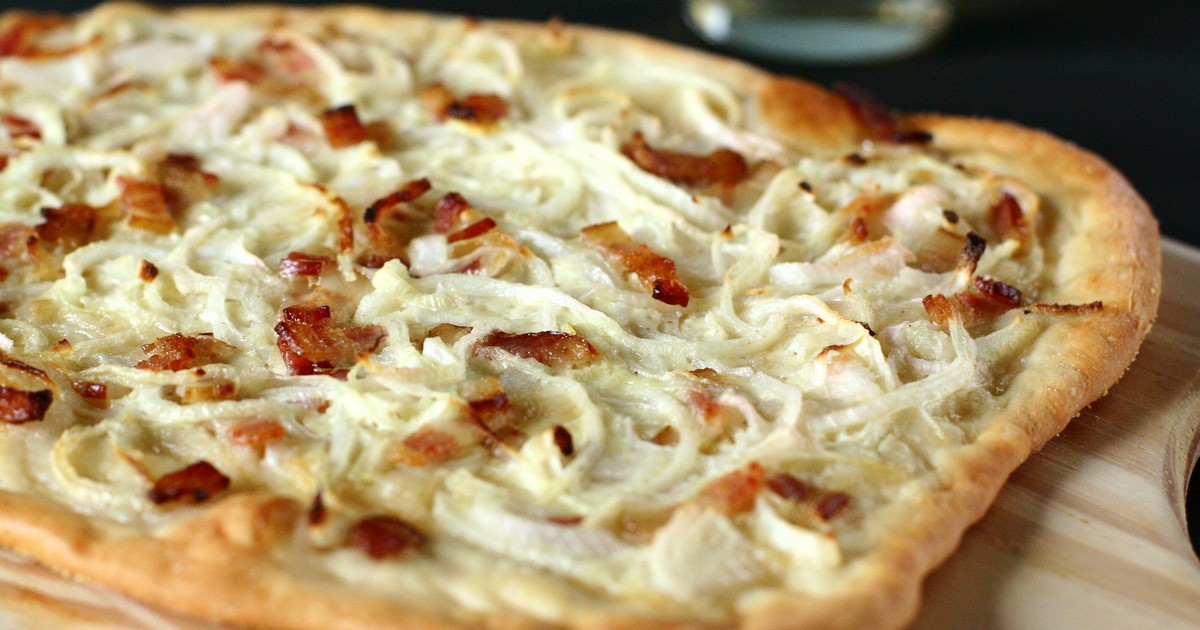
You set a tarte flambée on the table, you see the thin crust, the lardons and the cream, and you wonder how many calories just landed on the plate.
Short answer: a tarte flambée with lardons of about 250 g is 750 kcal, according to Ciqual 2025. A 200 g slice is 600 kcal. A 300 g slice goes up to 900 kcal. These calories come from an official entry, per 100 g. The weight is not an official serving.
What’s in a tarte flambée, and why that matters
In the photo, the dish is easy to recognise: a very thin crust, onions, lardons, and a layer of cream. In Belgium, you’ll find it prepacked at the supermarket, in a brasserie, or made at home, often under the name flammekueche.
The Ciqual table has an entry for the dish already prepared:
- Flammenkueche or tarte flambée with lardons, prepacked: 300 kcal per 100 g, with 8.81 g of protein, 14.8 g of fat, 31.8 g of carbohydrate, 1.7 g of fibre and 1.64 g of salt.
It looks light, because it’s thin. At the same weight, though, it’s more calorie-dense than a prepacked gratin dauphinois. Ciqual doesn’t spell out the recipe (how much cream, how many lardons, what kind of dough). A version that’s generous with cream, or more heavily topped with lardons, will have more calories, at the same weight, than a lighter one. The figures in the table refer to this “prepacked” entry.
How many calories, by weight?
The weights below are everyday orders of magnitude, not official servings. An individual slice often sits around 200 to 250 g. A more generous slice, or almost half a tart, gets closer to 300 g. For yours, the most accurate option is still to weigh it, or to photograph it in BiteFrame.
| Weight | Calories | Protein | Fat | Carbohydrate | Fibre | Salt |
|---|---|---|---|---|---|---|
| 150 g | 450 kcal | 13.2 g | 22.2 g | 47.7 g | 2.6 g | 2.5 g |
| 200 g | 600 kcal | 17.6 g | 29.6 g | 63.6 g | 3.4 g | 3.3 g |
| 250 g | 750 kcal | 22.0 g | 37.0 g | 79.5 g | 4.3 g | 4.1 g |
| 300 g | 900 kcal | 26.4 g | 44.4 g | 95.4 g | 5.1 g | 4.9 g |
| 350 g | 1,050 kcal | 30.8 g | 51.8 g | 111.3 g | 6.0 g | 5.7 g |
| 400 g | 1,200 kcal | 35.2 g | 59.2 g | 127.2 g | 6.8 g | 6.6 g |
The title “600 to 900 kcal a slice” matches 200 g and 300 g. The typical slice we highlight, 250 g, is 750 kcal.
Everyone has their own recipe. These figures are estimates, not a lab measurement.
Want to know how many calories are really in yours? Photograph it on the plate, preferably already cut into, so the thickness of the crust and the topping show. Try BiteFrame →
A simple homemade recipe, kept separate
The Ciqual entry above covers prepacked tartes flambées. If you make it yourself, the total depends on your ingredients. Here’s a simple version, with no added salt. The calories are calculated from the Ciqual entries for the ingredients. We don’t mix this total with the table for prepacked products.
For one tart, to share in two or three portions:
- 250 g thin pizza dough, prepacked, raw
- 120 g thick cream, 30% fat, from the chiller
- 80 g plain fromage blanc, 7–8% fat
- 120 g smoked lardons, raw
- 150 g raw onions, thinly sliced
- pepper
Preheat the oven to 250°C, with a tray or a baking stone if you have one. Roll the dough out very thin, roughly the size of a large baking tray. Mix the cream and the fromage blanc, add a little pepper, and spread this layer without making it thick. Scatter the onions and the lardons. Bake for 8 to 12 minutes, until the edges brown and the lardons take on colour. Serve at once.
The total, for the whole tart, comes to about 1,530 kcal, and about 8.0 g of salt from the ingredients. A half is therefore about 766 kcal, and about 4.0 g of salt. A third is about 511 kcal, and about 2.7 g of salt. That salt does not include what you add while cooking. After baking, the tart weighs less, because some of the water evaporates. The calories for the whole tart stay around 1,530. We can’t turn that into an exact figure “per 100 g cooked”, because we don’t know the weight after baking.
This homemade version, for a half, sits close to the 750 kcal of the typical slice in the table. The salt comes mainly from the dough and the lardons.
Salt: the point to watch
The World Health Organization recommends staying under 5 g of salt a day for an adult. A typical 250 g slice, according to Ciqual, already provides about 4.1 g of salt. A 300 g slice goes up to about 4.9 g. At 350 g, you go past the daily reference, around 5.7 g. In the homemade recipe above, the salt from the ingredients is already about 4.0 g for a half, because the dough and the lardons bring a lot of it. This calculation does not count salt added while cooking. Even if you don’t add any, the total is already close to the WHO reference.
And compared with other dishes?
A typical 250 g slice of tarte flambée (750 kcal) overshoots a typical tartiflette of 300 g (about 480 kcal), a typical gratin dauphinois of 300 g (339 kcal), and a typical hachis parmentier of 350 g (483 kcal). A typical quiche lorraine of 150 g comes to about 400 kcal, for a smaller slice, and stays well below. Even a lighter 200 g slice (600 kcal) still sits above those plates.
Got leftover onions and cream in the fridge? That is often enough
A homemade tarte flambée is often whatever’s already there: a bit of cream, an onion, some lardons, leftover fromage blanc. Photograph your fridge with BiteFrame: in the app’s camera, next to the product scan and the barcode, the “What am I cooking?” option spots the ingredients and suggests recipes with what you have to hand. Often, that’s already enough to put a dish together, without ordering in.
Estimating your tarte flambée from a photo with BiteFrame
With a tarte flambée, everything is in the thickness of the crust, the layer of cream and the size of the slice. Hard to count in your head. With BiteFrame, you take a photo and the AI estimates the calories and the macros. The simplest option: a photo of the slice already cut into, so the topping shows. If you buy a ready-made pack at the supermarket, scan the barcode to get the values from the label. It remains an estimate: check the weight and the amount of lardons in particular, and adjust if you need to.
Frequently asked questions
How many calories are in a tarte flambée?
About 750 kcal for a slice of about 250 g, according to the Ciqual entry “Flammenkueche or tarte flambée with lardons, prepacked” (300 kcal per 100 g). A 200 g slice is 600 kcal. A 300 g slice, 900 kcal. A large 350 g slice, 1,050 kcal. The weight is not an official serving.
Is a homemade tarte flambée the same thing?
Not necessarily. The Ciqual entry covers prepacked products. With the simple recipe above, the whole tart is about 1,530 kcal, or about 766 kcal for a half, and about 511 kcal for a third. That total comes from the ingredient entries, not from the “prepacked” entry. It does not include salt you add while cooking.
Is tarte flambée too salty?
A typical 250 g slice already provides about 4.1 g of salt, according to Ciqual, against a reference of 5 g a day for an adult (WHO). A 300 g slice goes up to about 4.9 g. At 350 g, you reach about 5.7 g. In the homemade recipe, the salt from the ingredients alone is about 4.0 g for a half, mainly because of the dough and the lardons. That figure does not count salt added while cooking.
Why does such a thin tart have so many calories?
Because the density is high: 300 kcal per 100 g, according to Ciqual. The dough, the cream and the lardons don’t take up much volume, but they count for a lot. That’s why the gap with a gratin, which is thicker and yet often has fewer calories at the same weight.
This information is given as a guide and does not replace advice from a health professional.
Sources
- Ciqual 2025 food composition table — Anses (open data file)
- Ciqual table — Anses, Flammenkueche or tarte flambée with lardons, prepacked (code 25550)
- Ciqual table — Anses, thin pizza dough, prepacked, raw (code 23402)
- Ciqual table — Anses, cream 30% fat, thick, chiller cabinet (code 19410)
- Ciqual table — Anses, fromage blanc, plain, 7–8% fat (code 19711)
- Ciqual table — Anses, smoked lardon, raw (code 28720)
- Ciqual table — Anses, onion, raw (code 20034)
- World Health Organization: sodium reduction
Photo: Lulu Durand, via Wikimedia Commons (cropped), CC BY 2.0