Calories in a gratin dauphinois: from 280 to 400 kcal
A gratin dauphinois of about 300 g is 339 kcal, according to Ciqual. Portion table, homemade recipe, salt. The weight is not an official serving.
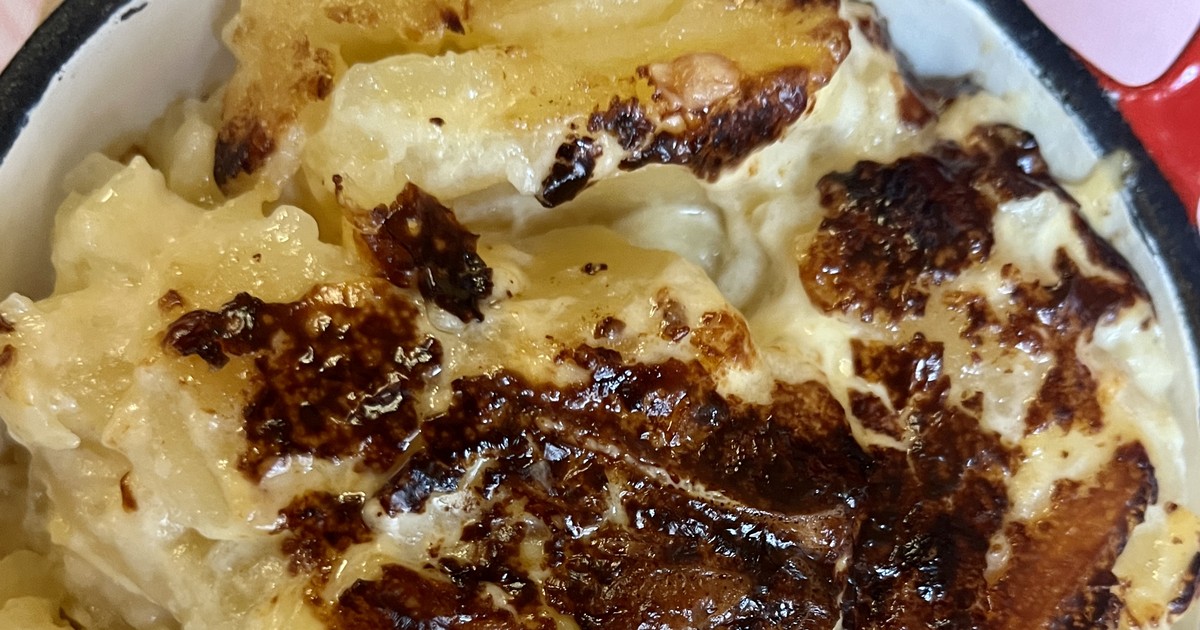
You serve a dish of gratin dauphinois, you see the cream-coated potatoes and the golden crust, and you wonder how many calories just landed on the plate.
Short answer: a gratin dauphinois of about 300 g is 339 kcal, according to Ciqual 2025. A 250 g portion is 283 kcal. A 350 g plate goes up to 396 kcal. These calories come from an official entry, per 100 g. The weight is not an official serving.
What’s in a gratin dauphinois, and why that matters
In the photo, the dish is still in its small casserole: you can see the layers of potato, the cream, and the browned top. In Belgium, you’ll find it in a supermarket tray, as a side in a restaurant, or homemade with leftover potatoes.
The Ciqual table has an entry for the dish already prepared:
- Gratin dauphinois, prepacked: 113 kcal per 100 g, with 3.38 g of protein, 4.2 g of fat, 14.5 g of carbohydrate, 1.5 g of fibre and 0.81 g of salt.
That’s an average of prepacked products. Ciqual doesn’t spell out the recipe (how much cream, whether there’s cheese, what kind of milk). A gratin made with plenty of cream, or finished with cheese, will have more calories, at the same weight, than a lighter version. The figures in the table refer to this “prepacked” entry.
How many calories, depending on the weight?
The weights below are typical ranges, not official servings. An individual tray, or a small casserole, often sits around 250 to 300 g. A slightly generous plate is closer to 350 g. For yours, the most accurate option is still to weigh it, or to photograph it in BiteFrame.
| Weight | Calories | Protein | Fat | Carbohydrate | Fibre | Salt |
|---|---|---|---|---|---|---|
| 200 g | 226 kcal | 6.8 g | 8.4 g | 29 g | 3.0 g | 1.6 g |
| 250 g | 283 kcal | 8.5 g | 10.5 g | 36.3 g | 3.8 g | 2.0 g |
| 300 g | 339 kcal | 10.1 g | 12.6 g | 43.5 g | 4.5 g | 2.4 g |
| 350 g | 396 kcal | 11.8 g | 14.7 g | 50.8 g | 5.3 g | 2.8 g |
| 400 g | 452 kcal | 13.5 g | 16.8 g | 58 g | 6.0 g | 3.2 g |
The 283 kcal figure for 250 g is 282.5 kcal rounded (113 × 2.5). In the title, we round it to 280 kcal, to make it easier to read. The generous 350 g plate, at 396 kcal, explains the “400 kcal” in the title.
Everyone has their own recipe. These figures are estimates, not a lab measurement.
Want to know how many calories are really in yours? Photograph it on the plate, preferably already cut into, so the layers show. Try BiteFrame →
A simple homemade recipe, kept separate
The Ciqual entry above covers prepacked gratins. If you make it yourself, the total depends on your ingredients. Here’s a simple version, without cheese. The calories are calculated from the Ciqual entries for the ingredients. We don’t mix this total with the table for prepacked products.
For one dish, to share in four portions:
- 1 kg raw potatoes, peeled and sliced
- 400 g pouring cream, 30% fat
- 200 g whole milk
- 1 garlic clove
- 10 g unsalted butter, for the dish
- nutmeg, pepper, and any salt you add
Preheat the oven to 170°C. Rub the dish with the garlic, then butter it. Arrange the potatoes in layers, without packing them too tightly. Mix the cream and the milk, add a pinch of nutmeg and pepper, and pour it over. Cover and bake for 50 minutes, then uncover for another 15 to 20 minutes, until the top is golden and the potatoes are tender. Leave it to rest for a few minutes before serving.
The total, for the whole dish, comes to about 2,180 kcal, and about 0.5 g of salt from the ingredients. One portion (a quarter) is therefore about 545 kcal, and about 0.1 g of salt. That salt does not include what you add while cooking. After baking, the dish weighs less, because some of the water evaporates. The calories for the whole dish stay around 2,180. We can’t turn that into an exact figure “per 100 g cooked”, because we don’t know the weight after baking.
This homemade version is richer than the average prepacked product, mainly because of the cream. If you add 50 g of grated emmental on top, count about 180 kcal and 0.3 g of salt extra for the whole dish, or roughly 45 kcal more per portion.
Salt: the point to watch
The World Health Organization recommends staying under 5 g of salt a day for an adult. A typical 300 g plate, according to Ciqual, already provides about 2.4 g of salt. A 350 g plate goes up to about 2.8 g. In the homemade recipe above, the salt from the ingredients stays low, around 0.1 g per portion, because this calculation does not count salt added while cooking (in the cream, on the potatoes or at the table). As soon as you salt the cream or the potatoes, the total moves closer to the prepacked entry.
And compared with other dishes?
A typical 300 g plate of gratin dauphinois (339 kcal) is lighter than a typical tartiflette of 300 g (about 480 kcal), and below a typical hachis parmentier of 350 g (483 kcal). A typical moussaka of 300 g (about 440 kcal) sits a little higher. A typical quiche lorraine of 150 g comes to about 400 kcal, for a slice half the size.
Got leftover potatoes in the fridge? That is often enough
A homemade gratin is often what’s already there: potatoes, a little cream, a little milk, a clove of garlic. Photograph your fridge with BiteFrame: in the app’s camera, next to the product scan and the barcode, the “What am I cooking?” option spots the ingredients and suggests recipes with what you have. Often there’s already enough to put a dish together, without ordering in.
Estimate your gratin in a photo with BiteFrame
With a gratin, everything is in the thickness of the cream and the size of the portion. Hard to count in your head. With BiteFrame, you photograph it and the AI estimates the calories and macros. The simplest way: a photo of the portion already cut into, so the layers show. If you buy a ready-made tray at the supermarket, scan the barcode to get the values from the label. It remains an estimate: check the weight and the amount of cream, and adjust if needed.
Frequently asked questions
How many calories are in a gratin dauphinois?
About 339 kcal for a plate of about 300 g, according to the Ciqual entry “gratin dauphinois, prepacked” (113 kcal per 100 g). A smaller 250 g portion is 283 kcal. A 350 g plate is 396 kcal. A large 400 g plate is 452 kcal. The weight is not an official serving.
Is a homemade gratin the same?
Not necessarily. The Ciqual entry covers prepacked products. With the simple recipe above, the whole dish is about 2,180 kcal, or about 545 kcal for one portion in four. That total comes from the ingredient entries, not from the “prepacked” entry. It doesn’t include the salt you add while cooking. This version, more generous with cream, has more calories than the average tray.
Is gratin dauphinois too salty?
A typical 300 g plate provides about 2.4 g of salt, according to Ciqual, against a reference of 5 g a day for an adult (WHO). A 350 g plate goes up to about 2.8 g. In the homemade recipe, the salt from the ingredients alone is about 0.1 g per portion. That figure does not count salt added while cooking: anything you add comes on top.
Is cheese required?
No. The classic recipe is often made without cheese, with cream and milk. Many homemade versions add a little on top. In the calculation above, 50 g of grated emmental adds about 180 kcal for the whole dish, or roughly 45 kcal per portion.
This information is given as a guide and does not replace advice from a health professional.
Sources
- Ciqual 2025 food composition table — Anses (open data file)
- Ciqual table — Anses, gratin dauphinois, prepacked (code 25056)
- Ciqual table — Anses, potato, without skin, raw (code 4008)
- Ciqual table — Anses, 30% fat cream, pouring, UHT (code 19417)
- Ciqual table — Anses, whole milk, UHT (code 19023)
- Ciqual table — Anses, garlic, raw (code 11000)
- Ciqual table — Anses, butter, minimum 80% fat, unsalted (code 16400)
- Ciqual table — Anses, emmental, grated (code 12118)
- World Health Organization: sodium reduction