How many calories in a quiche lorraine? From 270 to over 530 kcal
Quiche lorraine: about 400 kcal for 150 g, according to Ciqual. Portion table, homemade recipe, salt.
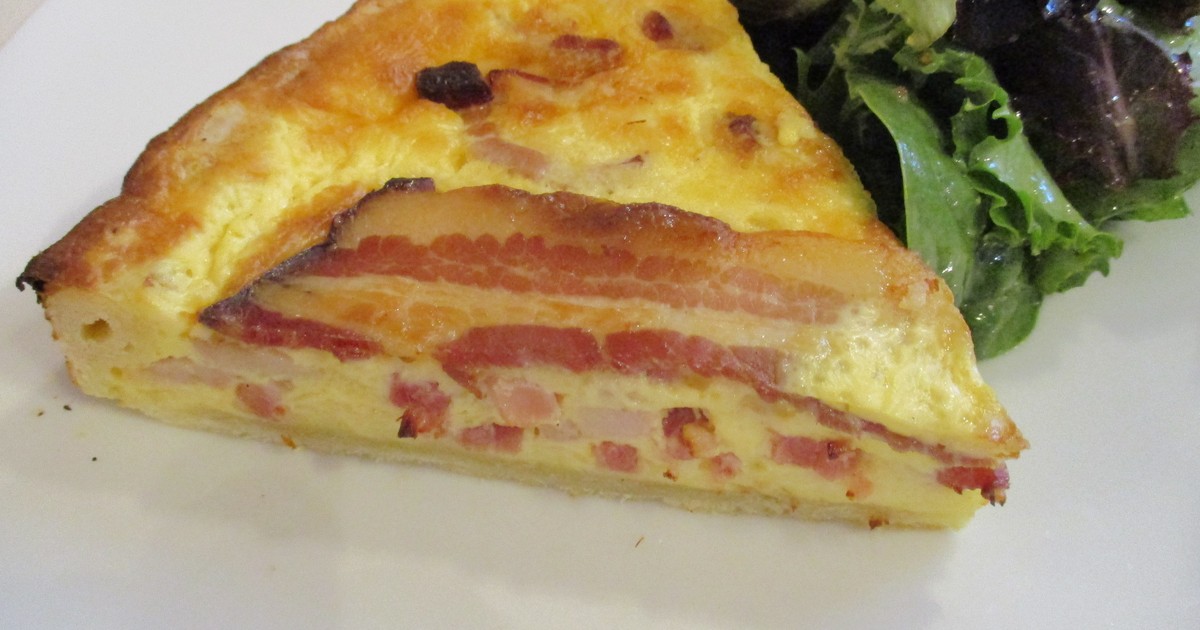
You cut a slice of quiche lorraine, you see the pastry, the yellow filling and the pieces of bacon, and you wonder: what did I just eat, exactly?
Short answer: a quiche lorraine of about 150 g is about 400 kcal, according to the Anses Ciqual 2025 table (the exact figure is 404 kcal). A smaller slice, around 100 g, stays at 269 kcal. A large slice of 200 g goes up to 538 kcal. These calories come from an official entry, per 100 g. The weight itself is not standardised: Ciqual does not define “a slice of quiche”.
What is in a quiche lorraine, and why it matters
In the photo, the slice is already cut: you can see the pastry, the egg-and-cream filling, and the layers of bacon. A side salad sits next to it on the plate. The figures below are for the quiche only, not the side. In Belgium, you find it as a slice in a restaurant, as an individual tart at the bakery, in a supermarket pack, or homemade at the weekend.
The Ciqual table has an entry for the ready-made dish:
- Quiche lorraine, prepacked: 269 kcal per 100 g, with 8.39 g of protein, 16.4 g of fat, 21.5 g of carbohydrate, 1.39 g of fibre and 1.01 g of salt.
This is an average of prepacked products. Ciqual does not spell out the recipe (thickness of the pastry, amount of bacon or cream). A very generous tart, or one with extra cheese, will be more caloric, at the same weight, than a lighter version. The figures in the table refer to this “quiche lorraine, prepacked” entry.
Ciqual also has a broader entry, savoury tart or quiche (average food): 268 kcal per 100 g, and 1.13 g of salt. The energy is almost the same. Here we rely on the precise “quiche lorraine” entry.
How many calories by weight?
The weights below are usual orders of magnitude, not official portions. A homemade slice, cut into six from a classic tin, often lands around 120 to 180 g. An individual bakery quiche can be smaller, or denser. For yours, the fairest option is still to weigh it, or to photograph it.
| Format | Weight (order of magnitude) | Calories (about) | Salt (about) |
|---|---|---|---|
| Small slice | 100 g | 269 kcal | 1.0 g |
| Typical slice | 150 g | 404 kcal | 1.5 g |
| Large slice | 200 g | 538 kcal | 2.0 g |
| Very large slice | 250 g | 672 kcal | 2.5 g |
For a typical 150 g slice, that is also about 13 g of protein, 25 g of fat, 32 g of carbohydrate and 2 g of fibre. The 404 kcal figure is the exact calculation (269 × 1.5). In the title, we round it to 400 kcal, to make it easier to read. The large 200 g slice, at 538 kcal, explains the “over 530 kcal” in the title.
Every kitchen has its own hand. These figures are estimates, not an absolute truth.
Want to know what yours is really worth? Photograph it on the plate, preferably already sliced, so the pastry and the bacon show. Try BiteFrame →
A simple homemade recipe, kept separate
The Ciqual entry above is for prepacked quiches. If you make it yourself, the total depends on your ingredients. Here is a simple version, without cheese — like a traditional quiche lorraine. The calories are calculated from the Ciqual entries for the raw ingredients. We do not mix this total with the table for prepacked products.
For one quiche, to share in six slices:
- 230 g shortcrust pastry, all-butter, raw
- 3 eggs (about 180 g)
- 200 g thick cream, 30% fat
- 150 g unsmoked bacon lardons, raw
Preheat the oven to 180 °C. Line a tin with the pastry. Fry the lardons in a pan, with no extra fat, then drain them. Beat the eggs with the cream, a little pepper, and only a pinch of salt if the lardons are already quite salty. Spread the lardons over the pastry, pour in the filling, and bake for 30 to 40 minutes, until the centre is set and the top is golden. Let it rest for a few minutes before cutting.
The total, for the whole quiche, comes to about 2,120 kcal, and about 8.7 g of salt. One slice (a sixth) is therefore about 354 kcal, and about 1.4 g of salt. After baking, the quiche weighs less, because some of the water leaves. The calories of the whole tart, though, stay around 2,120. We cannot derive an exact “per 100 g cooked” figure, because we do not know the weight after baking.
A traditional quiche lorraine is made without cheese. If you add 50 g grated emmental, count about 180 kcal and 0.3 g of salt extra for the whole tart, or roughly 30 kcal more per slice.
The restaurant version, and the individual quiche
In a restaurant, or at home with more cream and bacon, the quiche is often richer. The USDA, for its part, gives 387 kcal per 100 g for a “quiche with meat, poultry or fish”. A listed portion of 192 g, or one eighth of a 9-inch (23 cm) quiche, then comes to about 743 kcal. A listed individual quiche of 113 g comes to about 437 kcal. We do not mix these figures with the Ciqual table: it is not the same table, and not the same recipe. It simply helps to explain why a brasserie slice, or a very generously filled tart, can climb much higher than a supermarket pack.
Salt: the point to watch
The World Health Organization recommends staying under 5 g of salt a day for an adult. A typical 150 g slice, according to Ciqual, already provides about 1.5 g of salt. A large 200 g slice goes up to about 2.0 g. In the homemade recipe above, one slice is about 1.4 g of salt, mainly because of the lardons and the pastry. The whole quiche, on its own, goes over 8 g: if you have a second slice, the total rises quickly.
And compared with other dishes?
A typical 150 g slice of quiche lorraine (about 400 kcal) sits below a typical lasagna of 400 g (about 540 kcal) and below a typical burrito (about 600 kcal). Watch the weight: the lasagna in that comparison is a heavier plate. A large 200 g slice of quiche (538 kcal) already matches a typical lasagna.
Got eggs and cream left in the fridge? That is often enough
A homemade quiche is often what is already there: pastry, eggs, cream, a leftover pack of lardons. Photograph your fridge with BiteFrame: in the app’s camera, next to the product scan and the barcode, the “What am I cooking?” option spots the ingredients and suggests recipes with what you have to hand. Often, there is already enough to put a dish together, without ordering in.
Estimate your quiche in a photo with BiteFrame
With a quiche, everything is in the pastry and the filling. Hard to count in your head. With BiteFrame, you take a photo and the AI estimates the calories and macros. The simplest option: a photo of the slice already cut, so the thickness and the bacon show. If you buy a ready-made quiche at the supermarket, scan the barcode to get the values from the label. It remains an estimate: check the weight, the pastry and the bacon in particular, and adjust if needed.
Frequently asked questions
How many calories are in a quiche lorraine?
About 400 kcal for a slice of about 150 g, according to the Ciqual entry “quiche lorraine, prepacked” (269 kcal per 100 g). A small 100 g slice is 269 kcal. A large 200 g slice is 538 kcal. A very large 250 g slice is 672 kcal. The weight is not an official portion.
Is a restaurant quiche the same thing?
Not necessarily. The Ciqual entry covers prepacked products (269 kcal per 100 g). The USDA, for a quiche with meat, poultry or fish, gives 387 kcal per 100 g, and a listed 192 g portion comes to about 743 kcal. We do not mix the two tables.
How many calories are in a homemade quiche lorraine?
With the simple recipe above (pastry, eggs, cream, lardons, no cheese), the whole quiche is about 2,120 kcal, or about 354 kcal for one slice out of six. That total comes from the Ciqual ingredient entries, not from the “quiche lorraine, prepacked” entry.
Is quiche lorraine too salty?
A typical 150 g slice provides about 1.5 g of salt, according to Ciqual, against a reference of 5 g a day for an adult (WHO). A large slice goes up to about 2.0 g. In the homemade recipe, one slice is about 1.4 g of salt.
This information is given as a guide and does not replace advice from a health professional.
Sources
- Ciqual 2025 food composition table — Anses (open data file)
- Ciqual table — Anses, quiche lorraine, prepacked (code 25405)
- Ciqual table — Anses, savoury tart or quiche, average food (code 25573)
- Ciqual table — Anses, all-butter shortcrust pastry, prepacked, raw (code 23414)
- Ciqual table — Anses, raw egg (code 22000)
- Ciqual table — Anses, 30% fat thick cream, chilled section (code 19410)
- Ciqual table — Anses, unsmoked bacon lardon, raw (code 28501)
- Ciqual table — Anses, emmental or emmenthal, grated (code 12118)
- USDA FoodData Central, Quiche with meat, poultry or fish (FDC 2708731)
- World Health Organization: sodium reduction
Photo: Arnaud 25, via Wikimedia Commons (cropped image), CC0